
Freedom isn't free
The ability to change your mind when new evidence warrants it is the foundation of reason.

“Whatever happens, I can’t fall asleep. If I fall asleep, I’m a goner.” These were the thoughts of Ōsugi Sakae (1885-1923), 31, as he lay under his futon on February 8, 1916. He was 31 years old, and caught in the middle of a love quadrangle.
The woman lying next to him was Kamichika Ichiko. That night at the Hikage Tea House in Hayama, Kanagawa Prefecture, she was feeling passionately jealous.
Osugi had come to the town of Hayama, in Kanagawa prefecture, to stay at a rooming house and get some writing done. He was a political idealogue and translator, and he had some work to finish up. He had planned to go alone so he could concentrate.
When Kamichika arrived, though, she found that he had brought a girlfriend with him: Itō Noe. This was really not much of a surprise. Ito, Kamichika, and Osugi’s wife Hori Yasuko were all a part of a private social experiment, along with Osugi, in free love.
All three women were intellectuals. All three highly educated and well-read. Itō Noe was an accomplished writer and member of the Blue Stocking Society and knew its founder, Hiratsuka Raicho. This association alone made her a “new woman.” She was an editor and contributor to the magazine “Bluestocking.” This gave her a reputation as a woman of the people who refused to accept male dominance in Japanese society. In 1916, she began an affair with Kamichika, and with Osugi. Kamichika was a successful translator and feminist herself.
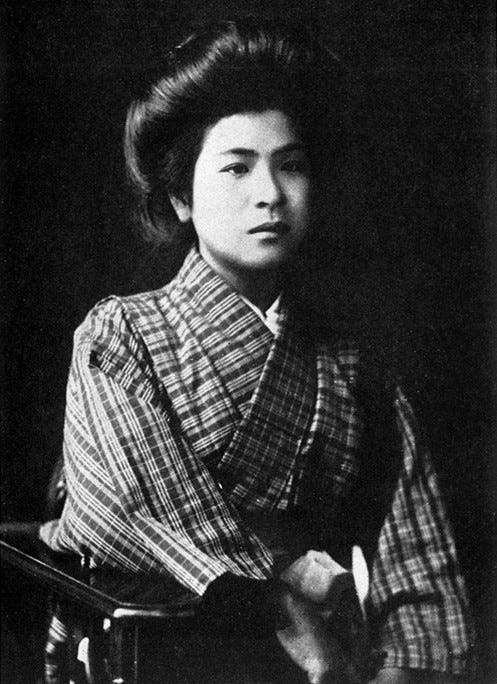
Ōsugi had started out on a military trajectory, his family’s traditional career path. His hatred of authority and a willingness to protest (he was arrested multiple times) on behalf of workers and ordinary people put him on the police radar, and ended his chances at joining the army. During his several stints in prison he read Japanese and foreign tracts on Marxism and Anarchism, coming under the influence of Mikhail Bakunin, Kōtoku Shūsui, Peter Kropotkin, and others. By 1918, he had drifted far to the left, and, with apparently prodigious intellectual gifts and a membership in the Heiminsha (People’s Society) was by then seen as one of the successors of Kōtoku Shūsui (1871-1911), former leader of Japan’s anarchists, who had been executed for plotting to assassinate the emperor in 1911, while Ōsugi was in Chiba Prison.
Before he became a labor leader and left-wing intellectual, though, Ōsugi experimented with the implications of his ideology in various ways. One of them, after 1911, involved advocating free love. An avowed anti-Capitalist, Ōsugi wrote that marriage was a contract in the capitalist sense of indicating ownership and profitability. He thus believed that an overthrow of capitalism would necessarily require the rethinking of marriage bonds and the recognition of the right of men and women to choose with whom, and when, they chose to indulge in romantic and sexual behavior. The so-called “Hikage Teahouse Incident” (hikage chaya jiken) involved Ōsugi and the three women with whom he was experimenting with free love.
Among the four of them there were three key rules which, according to Ōsugi, they had to follow to maximize individual choice in this relationship network. One, rather than rely on partners, they would recognize each other as individuals. Two, they would live separately from each other. Three, each would be responsible for their own financial well-being and not depend on the others.
The irony of this, according to the Asashi Shimbun’s article on the event in their “Record of the 20th Century” magazine series, was that the only one of the four who at the time was actually making a living on her own was Kamichika, who was able to live on her income from translations.
It was a messy affair. Hori Yasuko had a child with Ōsugi, and Kamichika had a child with a man she had recently divorced. Kamichika and and Hori were both 28 years old. Itō was 21. Ōsugi was 31.
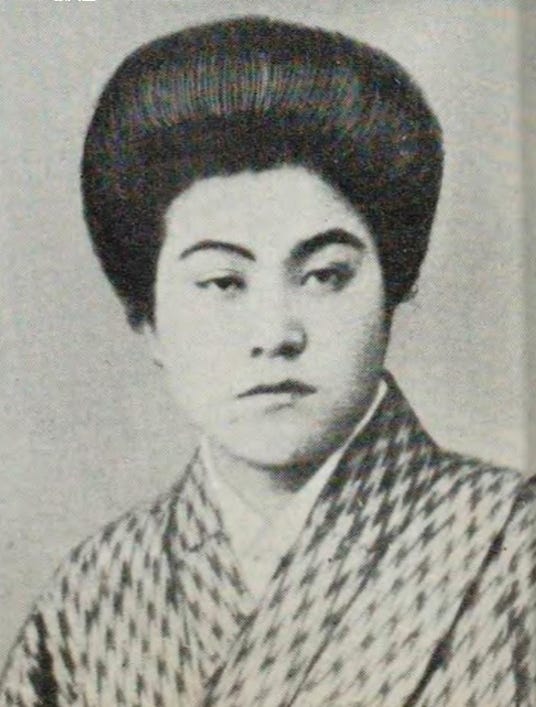
So when Kamichika Ichiko arrived at the Hikage Teahouse on the 8th of February and found that despite saying he would be alone, Ōsugi was accompanied by Itō, she apparently became angry. Itō made excuses and went home, leaving Ōsugi and Kamichika, with whom he had recently discussed a breakup, to deal with each other. Late that night, Ōsugi was under his futon when Kamichika came into the back room where he was sleeping, and told him that she no longer knew who he was - it was as if he were a stranger. Kamichika, according to Ōsugi’s account, was feeling murderous, and at one point told him, “stop fooling around. It’s time for me to stab you.” He feared she actually would if he dropped his guard and fell asleep.
He appears to have dropped his guard and fallen asleep.
At about 3:00 AM on February 9, she used a knife to stab him in the neck. He woke immediately, and says that he felt something like a ball of heat on his neck, and realized he had been attacked. He looked at Kamichika and thought she was holding a pistol (though it was likely the knife). As she opened the door to leave the room, she yelled “forgive me!” Then she slipped out and went to the police and turned herself in.
Though the incident itself provided sensational news fodder for weeks, in fact, it did not have terribly disabling effects on its participants. Ōsugi and Hori Yasuko, after his recovery, divorced. Ōsugi took up with Itō Noe. By all accounts they were a committed couple - apparently the Hikage incident had cooled their interest in free love. The two of them produced five children. Ōsugi enrolled in Tokyo University of Foreign Studies (Tokyo Gaikokugo Daigaku - at the time known as the Tokyo Foreign Language School) and eventually became, as noted above, a leader in Japan’s labor movement and one of the most important successors of Kōtoku Shūsui.
Hori Yasuko became a reporter for the Tokyo Nichi Nichi Shimbun (today’s Mainichi Newspaper).
Kamichika Ichiko, after serving two years in prison, wrote a memoir of her time, and the experiment in free love, with Ōsugi, noting ironically that she had broken one of his three rules - in reality, she said, the fact was that she had supported him financially. After paying her dues to society, Kamichika also won election to the national diet after the war, as one of Japan’s earliest women politicians.
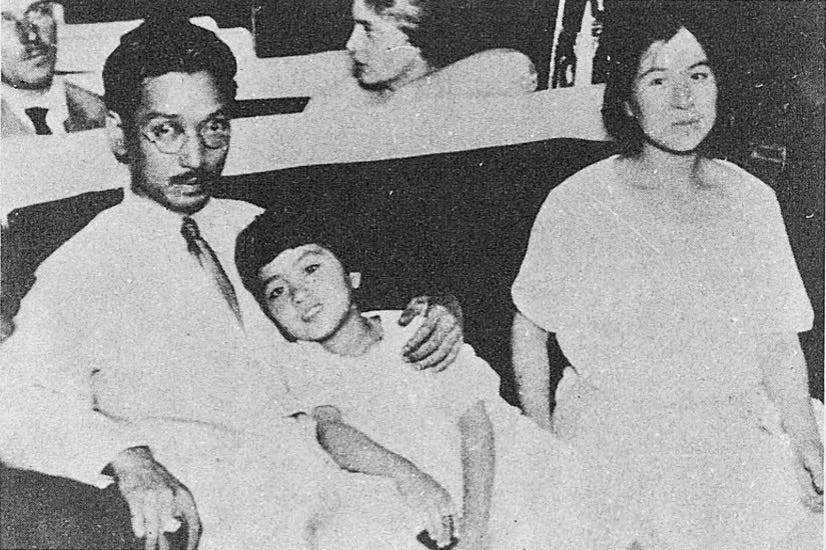
Ōsugi was killed, along with his wife Itō Noe and their six-year-old nephew in the wake of the 1923 Great Kantō Earthquake. They were recognized and arrested by a group of Kempeitai (special military police) who were crusing Tokyo “keeping the peace” - but perhaps in reality taking the opportunity to silence dissent - essentially taking part in the extrajudicial, and crowd-related killings that occurred in the thousands in the chaos after the quake. The group was commanded by the infamous Captain Amakasu Masahiko. He and his squad brutally beat and choked all three, then dropped their bodies in a well.
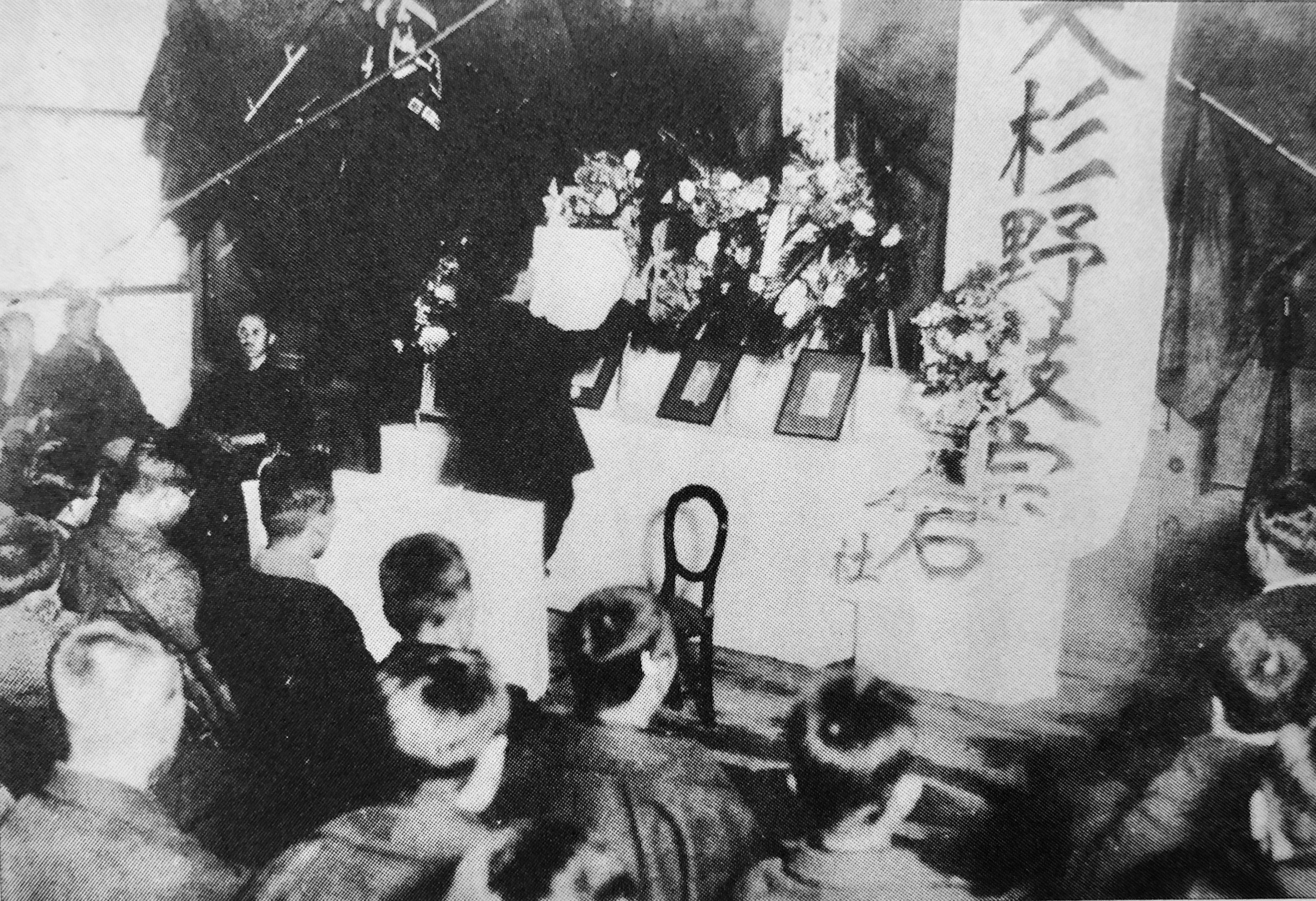
Amakusa was eventually charged and jailed for his role in this killing. However, as a right-wing fanatic willing to use any means necessary to achieve his goals, he was deemed too valuable to be left to waste in jail as Japan’s right wing grabbed control of the levers of power. He was eventually rehabilitated, and became the primary figure behind the rise of the Manchurian Film Association - the media and sometime propaganda arm of Japan’s effort to create and manage a puppet state in Manchuria. In that role, he was instrumental in managing the emergence and rise to fame of Yamaguchi Yoshiko.
It is interesting that ideology worms its way into so many of our human activities. In many ways, it can be used as justification for acts that seem unrelated to the politics it may have been invented for. So the question remains, despite his intellectual importance in Japan’s left wing and early labor movements, to what degree was Ōsugi’s free love idea just a self-serving extension of otherwise dearly-held beliefs? Whatever the case, evidence that he may have been wrong about this one seems to have caused him to change his mind.
Asahi Shimbunsha. “日録20世紀 (Daily Record of the Twentieth Century) 1916 (Taisho 9).” 1998.
Gordon, Andrew. A Modern History of Japan: From Tokugawa Times to the Present. Third international edition. Oxford University Press, 2014.
Gordon, Andrew. Labor and Imperial Democracy in Prewar Japan. University of California Press, 1991.
Pyle, Kenneth B. The Making of Modern Japan. 2. ed. Heath and Comp, 1996.